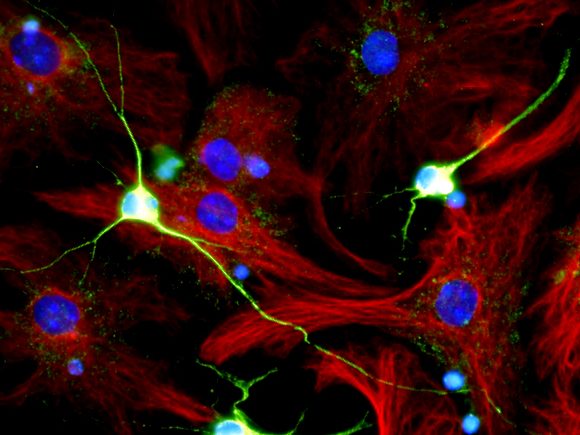
Have you heard the term “silent cortex”? The phrase was first coined by Karl Lashley and worked to support the common myth that humans only use 10% of their brain power at any given time. Karl’s research explored how different brain regions reacted due to electrical shock stimulation. He noticed that many brain regions were not impacted by the electrical stimulation. Therefore, he concluded that these areas had little to no function. This misinterpretation of preliminary neuroscience research set the stage for many of our misunderstandings of the brain and nervous system. Throughout scientific history, long-held misconceptions about scientific phenomena have temporarily halted scientific discovery and led to mistrust of the sciences. Despite new research altering our understanding of the world, many have held on to these misconceptions,
further interrupting scientific advancement. This paper will address the contradictory research that led us to debunk the myth, that people only use 10% of their brain at any given time, as well as explain why the myth prevailed for so long.
Another origin for this myth is because glial cells within the brain outnumber neurons 10:1. Since glial cells are viewed as supporting cells for neurons, which perform the information processing, it led people to think that only the neurons, which makes up 10% of the brain matter, are functioning. However, the brain has nearly 100 billion neurons constantly working to allow us to do basic functions such as breathing, as well as higher functions like driving a car. While glial cells don’t process information the way neurons do, it doesn’t
mean that they are useless or aren’t also constantly functioning. Our glial cells are vital to proper brain functioning because they work as immune cells, provide the necessary environment for neurons to thrive, and allow for efficient neuronal firing. Our brains only make up 2% of our body mass; however, it uses 20% of our daily energy intake. Our brains are constantly running at full capacity even when we are sleeping.
In addition, functional magnetic resonance imaging (fMRI) and positron emission tomography (PET) imaging confirms the findings that we are constantly using all regions of our brains. These imaging techniques allow researchers to view brain activity in real-time and have shown that our brains are firing even during the most mundane tasks such as watching paint dry. Further, they have shown how dynamic our brain processing
truly is and allows us to understand how different regions of the brain work together to facilitate our higher cognitive abilities. Lastly, we know that our brains follow the idea of “use it or lose it”. This principle is demonstrated during infant development when our brains undergo vast amounts of neuron growth. These neurons are pruned back as the child ages, allowing for only the necessary and strongest synaptic connections to
remain so that no energy or resources are expended on unused neural connections. This means that if we were only using 10% of our brains, then our brains would constantly atrophy from the inactivity, which is most definitely not occurring. As technology advances, we can better understand scientific phenomena more accurately. Given Lashley’s available technology his assumption was understandable, but as we learn more our understanding of science and the world around us should also change. A large part of why these misconceptions continue to this day, despite new research, is because individuals will blindly accept these myths as facts. Many people don’t think of doing their research own research because of the work and time required to do to. Further, this myth was perpetuated by the media and even by Ill-informed university professors. In 2014 the film Lucy was released and based its plot around the idea that if one could access the “unused” 90% of their brain, then they would be able to do impressive feats
like feel no pain or have telekinetic powers. For those forgetting Lucy is a science fiction movie, they may believe the myth and spread it. Not everything needs to be fact-checked, but one should evaluate where the information is coming from and how reliable the source is. In my case when I first heard about this myth in elementary school, I was told by a 5th grader who probably heard it from another 5th grader, a pool of not particularly educated individuals that likely didn’t do their research. Those ill-informed have always posed obstacles to countless scientific theory and accomplishment that exists. For example, the moon landed in 1969. Some people believe it was faked by the government, however,
given the technology available at the time. The iconic moon landing photo would be impossible to create. Some of the most contested scientific theories and practices include evolution, germ theory, heliocentrism, and many more. All of these have delayed scientific progress and explain why still so many believe that we only use 10% of our brain, when in reality our brain is constantly functioning.
https://www.nature.com/scitable/blog/mind-read/lucy_is_wrong_we_use/
https://www.oecd.org/education/ceri/neuromyth4.htm
 King Lab at Creighton University